Universal Serial Bus (USB) technology has become one of the most widely adopted standards for connecting devices to computers. From keyboards and mice to storage drives, smartphones, and network adapters, USB serves as a universal interface that simplifies communication between hardware components. Its convenience, plug-and-play functionality, and broad compatibility have made it indispensable in both personal and professional environments.
However, this very convenience has also introduced significant security challenges. Among the most concerning threats is the class of attacks known as BadUSB, which exploit fundamental design assumptions within the USB standard itself. Unlike traditional malware that targets software vulnerabilities, BadUSB attacks operate at the hardware and firmware level, making them particularly difficult to detect and mitigate.
This article provides a comprehensive exploration of BadUSB attacks, examining their underlying principles, methods of exploitation, real-world implications, and the challenges involved in defending against them.
The Concept and Origins of BadUSB
BadUSB refers to a type of attack that involves modifying the firmware of a USB device to alter its intended behavior. Every USB device contains a microcontroller responsible for managing communication with the host system. This controller runs firmware that defines how the device identifies itself and interacts with the computer.
In a typical scenario, a USB device honestly reports its identity—for example, as a storage device, keyboard, or printer. The operating system trusts this declaration and loads the appropriate drivers without extensive verification. This trust model is deeply embedded in the USB architecture and is essential for its ease of use.
BadUSB attacks exploit this trust. By reprogramming the firmware of a USB device, an attacker can cause it to masquerade as a completely different type of device. A seemingly harmless flash drive can present itself as a keyboard, a network adapter, or even multiple devices simultaneously. Because the operating system inherently trusts USB devices, it does not question this behavior, allowing the malicious device to operate freely.
Firmware Manipulation and Device Impersonation
At the heart of BadUSB lies the ability to modify the firmware of USB controllers. Many USB devices use generic microcontrollers that can be reprogrammed using specialized tools. Once compromised, the device can perform actions far beyond its original purpose.
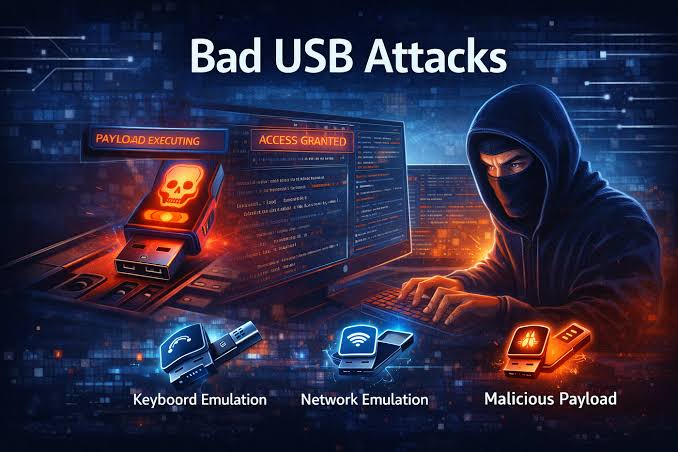
One of the most common techniques involves Human Interface Device (HID) spoofing. In this scenario, the USB device identifies itself as a keyboard. Since keyboards are trusted input devices, the system allows them to send keystrokes without restriction. A malicious USB device can exploit this by injecting commands at high speed, executing scripts, downloading malware, or altering system configurations.
Another powerful technique involves impersonating a network adapter. By doing so, the device can manipulate network traffic, redirect connections, or perform man-in-the-middle attacks. This enables attackers to intercept sensitive data, including login credentials and encrypted communications under certain conditions.
What makes these techniques particularly dangerous is that they do not rely on software vulnerabilities. Instead, they exploit the fundamental trust relationship between the operating system and hardware devices.
Execution of Malicious Actions
Once a BadUSB device is connected to a system, it can execute a wide range of malicious operations. These actions are often carried out rapidly and silently, leaving little time for the user to react.
A device impersonating a keyboard may open a command-line interface and execute a sequence of commands that download and install malware from the internet. It can modify system settings, disable security features, or create hidden user accounts with administrative privileges.
In more advanced scenarios, BadUSB devices can establish persistent access to a system. They may install backdoors that allow remote control, enabling attackers to monitor user activity, capture sensitive data, and execute commands at will. This level of control effectively compromises the entire system.
Additionally, attackers can use BadUSB to exfiltrate data. By acting as a storage device, the malicious hardware can copy files from the host system without the user’s knowledge. Alternatively, it can transmit data over a network interface that it controls.
Expanding the Scope Beyond Simple Devices
Although early discussions of BadUSB focused primarily on flash drives, the concept extends far beyond simple storage devices. Any hardware that uses a USB interface and contains programmable firmware can potentially be exploited.
This includes smartphones, webcams, USB hubs, docking stations, and even charging cables with embedded microcontrollers. In some cases, attackers have demonstrated malicious USB cables capable of injecting commands or establishing wireless communication channels.
The growing ecosystem of “smart” devices has further expanded the attack surface. As more devices incorporate advanced functionality and connectivity, the opportunities for exploitation increase. BadUSB is not limited to standalone attacks; it can also serve as an entry point for more complex, multi-stage intrusions.
Bypassing Traditional Security Mechanisms
One of the most troubling aspects of BadUSB attacks is their ability to bypass conventional security measures. Antivirus software and intrusion detection systems are typically designed to analyze software behavior. Since BadUSB operates at the firmware level, it often remains invisible to these tools.
Moreover, many security policies focus on restricting software execution rather than controlling hardware interactions. USB devices are generally trusted by default, and their actions are not subjected to the same scrutiny as executable files.
Even advanced security solutions that monitor USB usage may struggle to detect BadUSB attacks, as the device appears to function legitimately. For example, a keyboard sending keystrokes does not inherently raise suspicion, even if those keystrokes are malicious.
Real-World Implications and Attack Scenarios
The practical implications of BadUSB are significant. In environments where physical access to systems is possible, such as offices, public spaces, or shared workstations, attackers can easily deploy malicious USB devices.
A common attack scenario involves leaving infected USB drives in visible locations, relying on human curiosity to prompt users to connect them. Once plugged in, the device can execute its payload within seconds.
In corporate environments, BadUSB can be used for targeted attacks. An attacker with brief access to a workstation—perhaps posing as maintenance personnel—can insert a malicious device and compromise the system almost instantly.
The threat is not limited to individual machines. In networked environments, a compromised system can serve as a foothold for further attacks, enabling lateral movement and broader data breaches.
Challenges in Detection and Prevention
Defending against BadUSB attacks presents unique challenges. Because the attack originates from hardware, traditional software-based defenses are often insufficient. Detecting malicious firmware requires specialized tools and techniques that are not widely deployed.
One approach involves restricting access to USB ports. Organizations may disable unused ports or implement policies that limit which devices can be connected. While effective to some extent, this can reduce usability and may not be practical in all scenarios.
Another strategy focuses on device authentication. By requiring cryptographic verification of USB devices, systems can ensure that only trusted hardware is allowed to connect. However, this approach requires significant changes to existing infrastructure and standards.
Regular firmware updates for USB devices can also help mitigate risks, but this is often overlooked. Many devices do not support easy firmware updates, and users may be unaware of the need to maintain them.
The Role of User Awareness and Organizational Policy
Technical solutions alone are not sufficient to address the threat of BadUSB. User awareness plays a critical role in preventing attacks. Individuals must be educated about the risks associated with unknown or untrusted USB devices and encouraged to follow safe practices.
Organizations should implement clear policies regarding the use of external devices. This includes guidelines for handling USB drives, restrictions on personal devices, and procedures for reporting suspicious activity.
Training programs can help reinforce these policies, ensuring that users understand both the risks and the steps they can take to mitigate them. While human factors are often considered the weakest link in security, they can also serve as a strong line of defense when properly informed.
Future Directions and Emerging Solutions
As awareness of BadUSB grows, researchers and industry leaders are exploring new approaches to mitigate the threat. Advances in hardware security, such as secure enclaves and trusted execution environments, may provide additional layers of protection.
Improved authentication mechanisms for USB devices are also being developed, aiming to establish a stronger foundation of trust between hardware and operating systems. These solutions seek to balance security with usability, preserving the convenience that has made USB so popular.
In parallel, ongoing research continues to uncover new attack techniques and vulnerabilities. This highlights the need for continuous vigilance and adaptation in the face of evolving threats.

BadUSB represents a fundamental challenge to modern computer security, exposing weaknesses in the trust model that underpins one of the most widely used technologies in computing. By exploiting the firmware of USB devices, attackers can bypass traditional defenses, execute malicious actions, and compromise systems with alarming efficiency.
The threat extends beyond individual devices, affecting entire networks and organizations. Addressing it requires a comprehensive approach that combines hardware improvements, software defenses, organizational policies, and user education.
As technology continues to evolve, so too will the methods used by attackers. Understanding and addressing threats like BadUSB is essential to building more secure systems and maintaining trust in the digital infrastructure that underpins modern life.