The Illusion of Peripheral Trust
Modern computing systems are built on a foundation of speed, convenience, and seamless connectivity. Interfaces like Thunderbolt 3 were designed to deliver extraordinary data transfer rates, support multiple protocols, and simplify the user experience through a single versatile port. However, with this convenience comes a hidden cost. Beneath the surface of high-performance interconnects lies a powerful capability known as Direct Memory Access (DMA), which, while essential for performance, introduces a profound security risk.
The Thunderspy research exposes a harsh reality: even well-configured, fully encrypted, and locked systems can be compromised within minutes if an attacker gains brief physical access. This is not a theoretical risk—it is a practical, repeatable attack vector that challenges long-standing assumptions about device security.
Understanding Thunderbolt: Power and خطر in One Interface
Thunderbolt is not just another peripheral interface. Unlike traditional USB connections, Thunderbolt operates on top of PCI Express (PCIe), effectively giving connected devices direct access to system memory. This design enables exceptional performance, but it also means that devices connected via Thunderbolt can interact with the system at a very low level.
In a typical secure model, the operating system mediates access between hardware and memory. However, DMA bypasses the CPU and OS, allowing devices to read and write memory directly. This creates a situation where any malicious or compromised peripheral can potentially access sensitive data or manipulate system behavior without detection.
Thunderbolt 3 further complicates this by combining multiple functionalities—data transfer, video output, and power delivery—into a single USB-C connector. This versatility increases the attack surface while making malicious activity harder to distinguish from legitimate use.
The Core Idea Behind Thunderspy
Thunderspy is not a single vulnerability but a collection of design flaws that undermine the entire Thunderbolt security model. These flaws allow attackers to bypass all major protections that were intended to secure the interface, including device authentication, firmware integrity, and access control mechanisms.
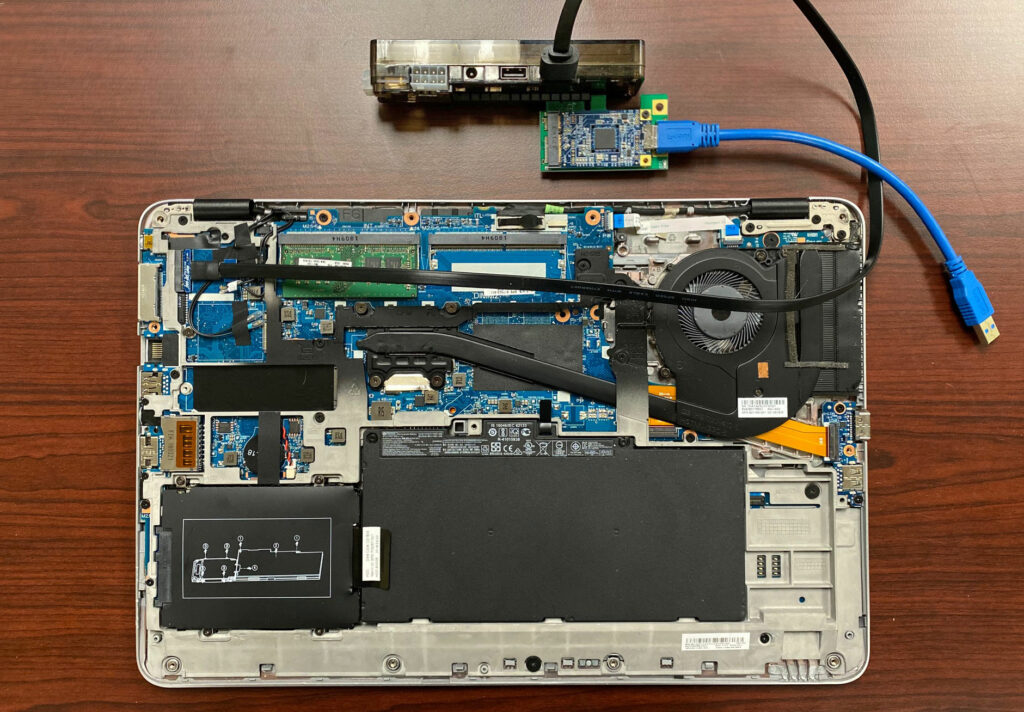
What makes Thunderspy particularly dangerous is its simplicity. An attacker does not need advanced malware deployment techniques, phishing campaigns, or user interaction. Instead, they only need a few minutes alone with the target device, some relatively inexpensive hardware, and basic technical knowledge.
Once access is obtained, the attacker can read and copy all data from the system, even if the disk is encrypted and the device is locked or asleep. This fundamentally breaks the assumption that encryption alone is sufficient to protect data at rest.
Breaking the Security Model: Where Things Go Wrong
The Thunderbolt security architecture was designed around several key assumptions. Devices must be authorized before gaining access, firmware should be protected against tampering, and cryptographic mechanisms should prevent spoofing. Thunderspy demonstrates that each of these assumptions can be violated.
One of the primary weaknesses lies in firmware verification. The system does not adequately ensure that the firmware controlling the Thunderbolt interface has not been modified. This allows attackers to reprogram the controller and alter its behavior without triggering any alarms.
Another critical issue is device authentication. Although Thunderbolt claims to support cryptographic authentication, the implementation is flawed. Attackers can clone the identity of a trusted device, effectively impersonating it and gaining full access without needing explicit authorization.
Additionally, the system relies on metadata that is not properly authenticated. This creates opportunities for attackers to manipulate configuration data and bypass security policies entirely.
The Role of Physical Access: A Short Window, Massive Impact
Unlike remote exploits, Thunderspy attacks require physical access. At first glance, this might seem like a limitation. In reality, it is one of the most dangerous aspects of the attack.
Physical access is often underestimated in threat models. People leave laptops unattended in offices, hotel rooms, airports, and conference venues. Even a few minutes can be enough for a determined attacker to execute the entire attack chain.
The attacker does not need to log into the system or interact with the user interface. They can operate entirely at the hardware level, modifying the Thunderbolt controller or connecting a malicious device that exploits DMA capabilities.
Because the attack leaves no traces, victims may never realize their system has been compromised.
Stealth and Persistence: Why Detection Is Nearly Impossible
One of the most alarming characteristics of Thunderspy is its stealth. Traditional security tools—antivirus software, intrusion detection systems, and logging mechanisms—are ineffective against this type of attack.
Since the attack occurs at the hardware level, it bypasses the operating system entirely. There are no suspicious processes, no unusual network activity, and no logs indicating unauthorized access.
Moreover, attackers can make persistent changes to the system. By modifying firmware, they can disable security features permanently and prevent future updates from restoring protection. This means the system remains vulnerable even after rebooting or reinstalling the operating system.
Advanced Exploitation Techniques
Thunderspy enables a range of sophisticated attack scenarios. Attackers can create arbitrary device identities, making it possible to impersonate trusted peripherals. They can also downgrade security configurations by exploiting backward compatibility features, effectively forcing the system into a less secure state.
Another powerful technique involves disabling Thunderbolt security entirely. By manipulating the controller firmware, attackers can remove all restrictions without the system reflecting any change in its configuration. From the user’s perspective, everything appears normal.
In more advanced cases, attackers can lock the system into a compromised state by preventing firmware updates. This ensures that even if vulnerabilities are discovered and patches are released, the device cannot be fixed.
Impact on Encryption and Secure Boot
One of the most troubling implications of Thunderspy is its ability to bypass full disk encryption technologies. Solutions like BitLocker or FileVault are designed to protect data when a device is lost or stolen. However, they rely on the assumption that the system’s hardware has not been compromised.
With DMA access, attackers can read memory directly, including encryption keys stored during system operation. This allows them to decrypt data without needing the user’s password.
Similarly, Secure Boot and strong BIOS passwords provide little protection against this class of attack. Since Thunderspy operates outside the normal boot process, these defenses do not prevent exploitation.
Affected Systems and Long-Term Consequences
The vulnerabilities exploited by Thunderspy affect a wide range of systems produced over nearly a decade. Any device equipped with Thunderbolt ports manufactured between 2011 and 2020 is potentially vulnerable.
Even newer systems that include Kernel DMA Protection are not completely safe. While these protections mitigate some attack vectors, they do not address the underlying hardware design flaws.
Perhaps the most concerning aspect is that these vulnerabilities cannot be fully fixed through software updates. Addressing them requires changes at the silicon level, meaning entirely new hardware designs.
Defensive Measures: What Can Be Done
While the situation may seem bleak, there are steps users and organizations can take to reduce risk. The most effective defense is limiting physical access to devices. This includes maintaining strict control over hardware, especially in public or shared environments.
Disabling Thunderbolt ports in the BIOS or UEFI settings can significantly reduce exposure. In cases where the ports are not needed, this is a straightforward and effective mitigation.
Using tools designed to assess vulnerability can also help identify at-risk systems. These tools analyze configuration settings and provide guidance on improving security posture.
However, it is important to understand that no software-based solution can fully eliminate the risk. Awareness and physical security remain the most critical defenses.
Rethinking Hardware Security
Thunderspy highlights a broader issue in modern computing: the gap between performance-driven design and security requirements. As systems become more complex and interconnected, the attack surface expands in ways that are not always fully understood.
The reliance on high-speed interfaces and direct memory access introduces risks that cannot be mitigated through traditional software defenses alone. This calls for a fundamental shift in how hardware security is approached.
Future designs must incorporate stronger isolation mechanisms, robust authentication protocols, and tamper-resistant firmware architectures. Without these changes, similar vulnerabilities will continue to emerge.
A Wake-Up Call for the Industry
Thunderspy is more than just a collection of vulnerabilities—it is a demonstration of how deeply embedded design assumptions can fail under real-world conditions. It challenges the belief that encryption, authentication, and secure configurations are sufficient to protect modern systems.
The reality is more complex. Security must be considered at every level, from hardware design to user behavior. Ignoring any layer creates opportunities for attackers to exploit.
For users, the lesson is clear: physical access matters more than most people realize. For manufacturers, the message is even stronger: security cannot be an afterthought. It must be built into the foundation of every system.
The era of trusting peripheral interfaces by default is over.